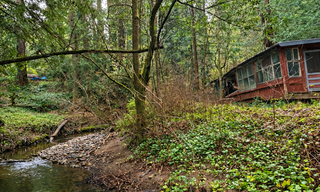
Now back in 1919 I had acquired . . . a plot amids the redwoods on the Alpine Creek at La Honda. There through the years I have built a humble retreat, my lodge, Chee-Chee-Wa-Wa, ‘neath the lords of the Chicsaw forest, and this nature’s sanctuary brings me to peace and rest and reflection.
In September 2026, Sam McDonald Park was officially listed on the Natural Register of Historical Places. This status will help preserve this national treasure and to raise the profile of the park’s original owner and namesake, Sam McDonald, carrying forward his desire to see the peace and grandeur of this place shared with the community.
Emanuel “Sam” McDonald (1884-1957) was a man celebrated in his own lifetime. A grandson of Louisiana slaves who left his family at age 16, Sam went on to become Stanford's first Black administrator as superintendent of athletic grounds and buildings. He was a man known and admired by many illustrious people of his day, including President Herbert Hoover and First Lady and geologist Lou Hoover (with whom Sam shared gardening tips). Many Stanford students and faculty cherished their friendship with Sam and he was famous his barbecues and for his dedication to the Stanford Convalescent Home for Children, or “Con Home,” for which he organized an annual student work party (later called “Sam McDonald Day").
In 1919 Sam purchased 430 acres of forest in La Honda and became the sole landowner of color in the California Redwoods. As he had at Stanford, Sam quickly endeared himself to village of La Honda, where he was often seen motoring up and down the wooded roads in his old, but well-kept Model B Ford roadster.

Sam built a lodge overlooking Alpine Creek. He named it Chee-Chee-Wa-Wa, which was believed to be a Native American word meaning “Little Squirrel.” He dammed the creek and created a pool, which he called “Lake Moqui” after a Hopi princess. It was to be a sanctuary, “an asylum to all the woodland creatures,” but also to Sam’s friends. At Sam’s invitation a steady stream of guests—students, sports officials, campus staff and their families—came to Chee-Chee-Wa-Wa to splash in chilly Lake Moqui and to enjoy Sam’s barbecue lamb and beef. After a disheartening loss in 1921 Stanford football coach Eugene Van Gent approached Sam, apologetic for the lateness of the request, but wondering if the team might come up for a last minute barbecue. The players had discussed it and had determined that only a barbecue at Chee-Chee-Wa-Wa could raise their spirits. Sam welcomed them with a barbecue “conducted in a spirit not before or since duplicated.”


This was Sam’s way. He loved sharing Chee-Chee-Wa-Wa with his friends and considered their visits an honor. He also loved the serenity he felt overlooking Lake Moqui and tromping up and down the densely wooded hills. “It is wisdom itself to find happiness with one’s fellow man,” he said. “Equally so with nature, the bounties of mother earth, and the creatures that walk, fly, creep, all begetting inspiration.”
Most of all Sam admired the redwoods, the “lords of the forest,” as he called them. Sam was a devoutly religious man whose eyes naturally turned heavenward and these giant trees inspired his loftiest thoughts and loftiest flights of language—“a Grand Aggregation of Lords” was one of his names for them. As Sam stood at 6’4”, his friends commonly noticed a likeness, both in stature and in noble nature, between Sam and the giant trees he loved.
At the end of his life Sam bequeathed his land to the Con Home, which a year later sold it to San Mateo County to keep as a sanctuary for woodland creatures, for trees, and for the people who delight in them. Sam McDonald is a hero of San Mateo County Parks. He's a reminder of the spirit in which this land has been preserved and of the kinds of moments that are possible here, moments spent connecting with others, moments spent connecting with nature.
We invite you to walk with Sam McDonald among his “lords of the forest.” To see the most "lordly of the lords," make your way along Sam McDonald Park’s Heritage Trail to Heritage Grove, one of the last remaining stands of old-growth coastal redwoods in the Santa Cruz Mountains. These trees, some standing as high as 280 feet, are estimated to be 1,500 years old. We think Sam would welcome you here and remind you, in the presence of these lordly trees, to look up!
More about Sam and Sam McDonald Park
- Shortly after leaving his family at age 16, Sam worked as a chore boy, swamper, and galley hand on the San Francisco-Sacramento riverboat Modoc. This is also the name of one of the youth campgrounds at Sam McDonald Park.
- Sam was a national authority on running tracks and replaced Stanford's Angell Field track, which was originally surfaced with crushed rubble from the 1906 earthquake, with a state of the art track. He devised a much-copied method of mowing athletic fields in opposite directions at regular intervals to give the appearance of striped turfing.
- During World War II, when Christmas trees were in short supply due to a manpower shortage, Sam would rove his property looking for the perfect Christmas tree to deliver to the Stanford Convalescent Home for the children to decorate. He also enjoyed playing his concertina for them.
- Sam attended every “Big Game” (a rivalry game between Stanford & Cal Berkeley) for 50 years running. Sadly, he died just before the 1957 Big Game. That evening when the band celebrated victory by taking the field and playing the Stanford anthem, instead of standing in the traditional “axe” formation they formed the letters: S-A-M.
- Chee-Chee-Wa-Wa Lodge was used as a honeymoon getaway by Sam’s student friends. The lodge is still standing, though damaged by flood water. It’s still painted red, too. In tribute to the redwood ‘lords of the forest’? Perhaps. But more likely: a tribute to Stanford football.