San Mateo County’s Economic Mobility Framework was developed through an extensive planning process by the Shared Prosperity Coordinating Council (SPCC), a group of leaders from county and local government, nonprofit, and private sector organizations that seek to advance economic mobility and promote shared prosperity in a county that suffers from significant disparities in income and opportunity.
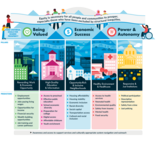
The SPCC adapted the Urban Institute’s Upward Mobility Framework , which provides an evidence-based foundation for efforts to advance economic mobility for people and communities. Using the Urban Institute’s holistic definition of economic prosperity, the SPCC established three Universal Prosperity Goals, supported by five pillars of support people need from their communities, and 31 predictors of the strength of these pillars that communities can influence to help more residents reach long-term prosperity.
The SPCC conducted a planning process to analyze data, discuss issues with local impacted communities, review best practices, and assess the existing landscape of efforts underway to address the challenges. Through this process, the SPCC developed an Economic Mobility Action Plan that identifies 10 strategies to move the needle on economic mobility in San Mateo County.




The SPCC developed and applied six principles for economic mobility action planning. These principles can serve as a blueprint for other strategic planning and decision-making efforts. Read the Economic Mobility Action Plan for more details on these planning principles.
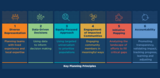
1. Diverse Representation: Conducted an internal demographic and lived-experience survey of its membership to ensure the group reflects the diversity of our county and represent the concerns of our most impacted communities through their personal and professional experiences
2. Data-driven Decisions: Reviewed mobility metrics—data indicators identified by the Urban Institute’s panel of experts to provide insight into local economic mobility conditions—as well as other local data sources
3. Equity-focused Approach: Utilized the Targeted Universalism approach by setting universal goals and disaggregating data to determine which sub-populations are most challenged to meet the goal and what targeted strategies could support these groups
4. Engagement of Impacted Communities: Incorporated data from three large-scale community engagement efforts conducted by the County of San Mateo in partnership with cities and local community organizations
5. Initiative Mapping: Analyze the landscape of all efforts to fill critical gaps.
6. Accountability: Established best practice for promoting transparency, validating impact, tracking progress, and learning and adjusting as the work begins.
