

REDWOOD CITY – Elected officials from across San Mateo County on Thursday warned that a state funding shortfall projected to approach $226 million could force significant cuts to public safety, health care, libraries, parks, roads and other essential services unless California lawmakers agree to a permanent solution.
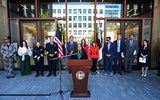
Speaking at a news conference outside County Center, County and city leaders joined police and fire chiefs, representatives from labor and health care organizations to describe what the growing Vehicle License Fee (VLF) replacement funding shortfall could mean for residents from Daly City to East Palo Alto.
“Let me tell you exactly what $134 million dollars in county cuts looks like. It means more than 600 critical public servants working at the county are on the chopping block. The very resources required to maintain our infrastructure, our resilience, and our community's fundamental quality of life will be stripped away,” Supervisor Ray Mueller said. “We are asking Sacramento to return the tax dollars we already paid. Today we renew our call to the Governor and the leaders of the legislature: uphold the promise CA made so many years ago and return our tax dollars to end this new annual dance with devastation for our cities and for our county.”
The County government’s share of the projected $226 million countywide shortfall is approximately $134 million, with the remainder affecting the county’s 20 cities and towns.
“When it comes to budgeting for the Fire Department, there is practically nothing that we can cut that doesn’t immediately affect our operations, our service to the community,” said Central County Fire Chief Dave Pucci, who also serves as president of San Mateo County Fire Chiefs Association. “At the Foster City incident just a little over a week ago, there were 150 firefighters committed to that incident for well over a day, and at the same time that incident is going on, we're still answering multiple other 911 calls, structure fires and medical calls around the county. We cannot have reduced number of apparatus with these cuts.”

Speakers laid the blame squarely on the state.
“This is not an unforeseen crisis,” Board of Supervisors President Noelia Corzo said. “This is a crisis the state created and is choosing not to solve.”
Hundreds of people gathered outside County Center for the news conference and a joint meeting to discuss the growing shortfall, potential budget and service reductions and the urgency of continuing efforts to secure a permanent funding solution from the state.
The amount owed exceeded $100 million last year and is projected to approach $226 million in the coming year. That amount, officials said, equates to approximately 1,000 County and city jobs.
Officials stressed that decisions about specific cuts have not been made, but given the magnitude of the shortfall, this is not fiscally sustainable without cuts to staffing, services and programs.
Securing a permanent legislative solution remains the County’s highest legislative priority. The County and cities are seeking a legislative amendment that would ensure they receive the replacement funding due without further state action, as does nearly every other county in California.
The issue today stems from a state budget deal cut in 2004, when California reduced the Vehicle License Fee rate paid by vehicle owners, and enacted a law to provide replacement funding to counties and cities.
For nearly every other county in California, that system works: Fifty-five counties receive more than $12 billion annually without question or delay. But through no fault of their own, San Mateo County and its 20 cities and towns do not receive their full replacement funding without further state action.
For six consecutive years, the Legislature, with strong support from San Mateo County’s legislative delegation, has approved one-time appropriations covering all or a substantial portion of the gap. Those appropriations have helped local governments maintain services but have not fixed the underlying flaw in the state’s funding formula.
The County of San Mateo has drawn heavily on reserves to protect residents from the immediate consequences. The County has used approximately $40 million from reserves in each of the past two years to replace funding it did not receive from the state -- $80 million in all.
County officials said that approach is not sustainable.
“This is the seminal fiscal issue this County has faced in its modern history,” County Chief Executive Mike Callagy said. “The loss of these dollars will mean staggering, systemic changes for San Mateo County and will change the face of our county.”
Other communities are proactively making tough budget choices based on the state’s stance.
“Let me share with you the real impacts of these cuts imposed by the state. We eliminated three firefighter positions… . We eliminated one police officer position, reducing our proactive capacity for community policing,” said San Bruno City Manager Alex McIntyre. “In sum, we cut eight positions. But wait, there’s more. We recently learned that San Bruno has to cut further and deeper.”
Labor representatives said the effects of cutbacks would reverberate across the community and affect the quality of life.
“When we lose a public employee, we lose twice,” said Julie Lind, executive officer of the San Mateo County Labor Council. “The family loses income, health care, stability, and the community loses the person who was there to serve us. The social worker already carrying a full caseload gets even more families to help. The public works crew takes longer to clear storm damage. The building inspector takes longer to get your permit approved. The library cuts hours, and the recreation program your child loves loses staff. And when you call 911, there may be fewer people to answer and respond. These aren’t scare tactics.”
County and city officials have worked closely with the local state legislative delegation, which has repeatedly secured funding to fill the annual gaps and advocated for a permanent solution. But officials say the Governor’s Office has not yet supported a permanent change to the funding formula.
The County has shown leadership in state priorities by investing significant local resources to advance state priorities, including converting hotels and motels into permanent supportive housing through Project Homekey, opening the County’s Navigation Center to address homelessness and investing local dollars in wildfire prevention, fuel reduction and emergency preparedness.
The County is one of the state’s largest economic engines, generating more than $217 billion in economic output in 2024 and ranking fifth among California’s 58 counties.
“I'm wearing red today because I'm red-hot mad at the governor of the State of California,” Supervisor Jackie Speier said. “This is money that is paid by the taxpayers of San Mateo County for the services in San Mateo County and the cities in San Mateo County. This is not money that we’re asking for. This is money that is owed us. It is a theft by the state of California, and we should call it that.”
Additional information, including the estimated funding shortfall for San Mateo County and each of its 20 cities and towns, is available at smcfairfunding.org.
Additional Quotes:
Kristina Bell, Redwood City Chief of Police:
“When someone dials 911 on the Peninsula, they aren’t thinking about state tax formulas or state budget adjustments. They expect a fast, professional response from an officer in their moments of greatest need.”
“The very programs that keep crime low, like our mental health co-responder teams, youth diversion, traffic safety task forces and specialized investigative units, those are the first on the list for budget cuts.”
Alex Khojikian, San Mateo City Manager
“For the City of San Mateo, a city of 105,000 residents, we went from a $7.1 million shortfall to a $12.9 million shortfall overnight.”
“Eighty percent of that budget shortfall is our staff. It pays for essential services that we provide to our community, so really, what we need is that permanent solution. We need predictability, and I just appreciate us being out here having a call to action today, a collective call to action to ask for a permanent solution to this VLF revenue shortfall.”
Julia Mates, Belmont Mayor:
“The state is asking cities like Belmont to build more housing and shoulder the cost of that growth, but the state is also withholding the very funding we rely on to absorb those costs. Governor Newsom, you can't ask cities to build more housing and welcome more residents, then refuse to repay us the money it costs to serve those residents.”
Rob Larcina: San Mateo Medical Center, Chief Nursing Officer:
“Nursing positions are not line items on a budget. I'll repeat that: nursing positions are not line items on a budget.
“They are essential part of the infrastructure that allows us to care for people when they need us the absolute most. Every position represents a nurse who is there to recognize a change in a patient’s condition, prevent harm, comfort a frightened family, advocate for a patient who has no voice, and help navigate their needs during one of the most difficult moments of their life.”
About San Mateo County
Established in 1856, the County of San Mateo stretches from the Pacific Ocean to San Francisco Bay and includes 20 cities and rural communities. Home to more than 750,000 residents, it is one of California’s most diverse counties with an economy driven by innovation, life sciences, agriculture and international trade and travel. In addition to serving unincorporated communities, the County provides countywide services that support the health, safety and quality of life of residents. Learn more at smcgov.org.
Effie Milionis Verducci
Director, Strategic Communications & Community Partnerships
County of San Mateo
C: (650) 407-4915
everducci@smcgov.org