Call the National 24/7 Human Trafficking Hotline (https://humantraffickinghotline.org/en):
Call: 1-888-373-7888
Text: 233-733
Submit a tip? Have questions? The Human Trafficking Prevention and Enforcement Initiative can be reached through this email address: httips@smcgov.org
The National Center for Missing & Exploited Children (https://www.missingkids.org/gethelpnow) 24/7 hotline:
Call: 1-800-843-5678
Background
Human trafficking is modern-day slavery and a grave violation of human rights. Victims are exploited through forced labor, domestic servitude, or commercial sexual exploitation, including the Commercial Sexual Exploitation of Children (CSEC). Both foreign nationals and U.S. citizens are affected, and San Mateo County is not immune to this crime.
Under California Penal Code §236.1, human trafficking is defined as depriving or violating the personal liberty of another with the intent to obtain forced labor, services, or commercial sexual exploitation. This aligns with the federal definition under the Trafficking Victims Protection Act (TVPA).
San Mateo County has made the eradication of human trafficking a priority. To this end, our county’s law enforcement agencies are committed to working together in collaboration with victim service providers and local nonprofit organizations to ensure that victims are supported with care and compassion and traffickers are held accountable.
These collaborative efforts are guided by the “4P Model” — Prevention, Protection, Prosecution, and Partnership. This model promotes collaborative efforts among law enforcement organizations, victim services providers, and community- and faith-based organizations devoted to identifying trafficking incidents, investigating and prosecuting offenders, assisting victims as they move forward to become survivors, raising public awareness of trafficking and, together, making effective efforts to prevent exploitation.
Possible indicators of a sex trafficking victim
- Appears overly fearful, submissive, tense, or paranoid, especially around a companion or “manager”
- Defers to another person to speak, or the companion insists on answering questions for them
- Branding, tattoos, or markings (e.g. “owner” marks, money/sex related symbols)
- Clothing that is inappropriately sexual for weather or context, or wardrobe controlled by someone else
- Lives where they work (e.g. in a “massage” business, escort residence) or is not free to leave
- Multiple phones, frequent use of burner phones, changing contact numbers often
- Signs of physical abuse, neglect, sexually transmitted infections, repeated pregnancies, genital trauma
- Unexpected or unexplained wealth (new clothes, jewelry, phone) without clear income source
- Minor engaged in commercial sex acts or coerced into sexual behavior
- Frequent travel to other cities for sexual services, or escort-advertisement activity online
Possible indicators of a labor trafficking victim
- Being paid little or not at all, or employer not honoring promised wages, withholding pay or deductions unexplained
- Owing a debt to employer or recruiter that must be “worked off” under coercive terms (“debt bondage”)
- Loss of control over identity documents (passport, IDs, work permits) held by someone else
- Working under extremely long hours, excessive overtime, always “on call”
- Living in or near the workplace under poor conditions (sleeping on site, substandard housing)
- Isolation from others / restricted contact with the outside world (no ability to leave, monitor communications)
- Threats, intimidation, withholding food or basic necessities, or other coercive control tactics
- Substandard or hazardous working conditions without protective gear or safety measures
- Little or no ability to negotiate employment conditions, or fear of retaliation for asking questions
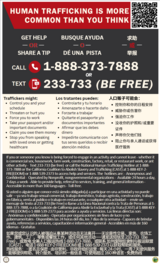
Human Trafficking Poster
Pursuant to CA Civil Code § 52.6 (https://leginfo.legislature.ca.gov/faces/codes_displaySection.xhtml?lawCode=CIV§ionNum=52.6.) each of the following businesses and other establishments shall, upon the availability of the model notice described in subdivision (d), post a notice that complies with the requirements of this section in a conspicuous place near the public entrance of the establishment or in another conspicuous location in clear view of the public and employees where similar notices are customarily posted:
- On-sale general public premises licensees under the Alcoholic Beverage Control Act (Division 9 (commencing with Section 23000) of the Business and Professions Code).
- Adult or sexually oriented businesses, as defined in subdivision (a) of Section 318.5 of the Penal Code.
- Primary airports, as defined in Section 47102(16) of Title 49 of the United States Code.
- Intercity passenger rail or light rail stations.
- Bus stations.
- Truck stops. For purposes of this section, “truck stop” means a privately owned and operated facility that provides food, fuel, shower or other sanitary facilities, and lawful overnight truck parking.
- Emergency rooms within general acute care hospitals.
- Urgent care centers.
- Facilities that provide pediatric care. For purposes of this section, “facilities that provide pediatric care” means a medical facility that provides pediatric services, as that term is defined in Section 16907.5 of the Welfare and Institutions Code.
- Farm labor contractors, as defined in subdivision (b) of Section 1682 of the Labor Code.
- (Privately operated job recruitment centers.
- Roadside rest areas.
- Businesses or establishments that offer massage or bodywork services for compensation and are not described in paragraph (1) of subdivision (b) of Section 4612 of the Business and Professions Code.
- Hotels, motels, and bed and breakfast inns, as defined in subdivision (b) of Section 24045.12 of the Business and Professions Code, not including personal residences.
- Hair, nail, electrolysis, and skin care, and other related businesses or establishments subject to regulation under Chapter 10 (commencing with Section 7301) of Division 3 of the Business and Professions Code.
Please refer to the Civil Code for the required language. You may use the attached flyer if you wish; it is fully compliant with the code.